Fortune.com more than doubled its RPM in 45 days without handing over control of its ad business. Fortune already had a strong direct-sales team and deep brand relationships. What it lacked was technical capacity: its internal AdOps team was running a self-managed header bidding wrapper on top of everything else. Freestar embedded engineers and yield specialists inside that team. We took on the execution work while Fortune kept ownership of its sales strategy.
- An extension of Fortune’s AdOpsEmbedded Freestar engineers and yield specialists took on technical execution. Fortune kept ownership of sales strategy.
- One decisioning layerDynamic Ad Stack and Flex brought publisher-owned and programmatic demand into a single auction.
- Revenue up, experience intactPage performance and Core Web Vitals improved alongside revenue.
The Brief
Fortune.com had a strong direct-sales motion and deep brand relationships. Programmatic was anchored to a self-managed OpenWrap header bidding wrapper, requiring internal AdOps to manage optimization, troubleshooting, and reporting. Publisher-owned demand and programmatic optimization operated in parallel rather than through a unified decisioning layer.
- Self-managed OpenWrap wrapper
- Internal AdOps running optimization and reporting
- Ad-hoc performance checks
- Direct and programmatic demand in parallel
- Embedded engineers and yield specialists
- Always-on performance monitoring
- Dynamic Ad Stack
- Flex unified decisioning
The Solution
Fortune didn’t need a new ad stack built around it. It needed more technical depth behind the team it already had. Freestar plugged into Fortune’s existing operation and took on the execution work that had sat with internal AdOps.
- Embedded team: Dedicated Freestar engineers and yield specialists worked as an extension of Fortune’s AdOps team. Optimization, troubleshooting and reporting had been handled in-house on a self-managed OpenWrap wrapper. That work moved to Freestar, and Fortune kept full ownership of its sales strategy and brand relationships.
- Continuous yield: Performance management moved from ad-hoc checks to data-driven, always-on monitoring.
- Unified decisioning: Publisher-owned demand and programmatic demand used to run in parallel. With Dynamic Ad Stack and Flex, both now compete in a single decisioning layer.
“The flexibility you offered allowed us to keep what worked for us while adopting exactly what we needed from your team.”
Jeff Li · Head of BD, Programmatic, Digital Revenue Partnerships · Fortune Media
The Results
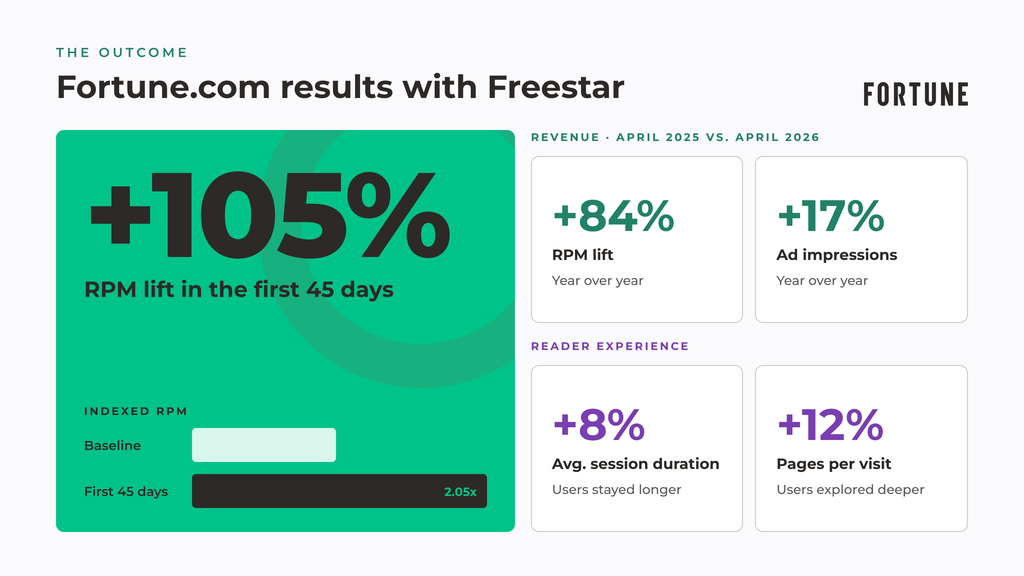
The impact showed up quickly. RPM more than doubled in the first 45 days, and a year later the gains have held.
The results trace back to the changes in the stack. Putting direct and programmatic demand into one auction increased competition and made demand prioritization clearer. Centralized floors and smarter decisioning made yield more consistent. Fortune’s team also gained clear visibility into what drives performance, with less operational work on their plate.
Page performance and Core Web Vitals improved over the same period, and users stayed longer and explored deeper.
Why It Matters
Page performance and Core Web Vitals improved alongside revenue. Users stayed longer and explored deeper, confirming that yield gains came without compromising the reader experience.
- Auction: Increased competition and clearer demand prioritization.
- Yield: More consistent yield via centralized floors and smarter decisioning.
- Confidence: Clear visibility into performance drivers; reduced operational burden.
- Focus: Internal teams stay focused on content and direct sales.
Join the World’s Most Trusted Publishers
See why industry leaders like Fortune Media and The Associated Press trust Freestar to power their growth